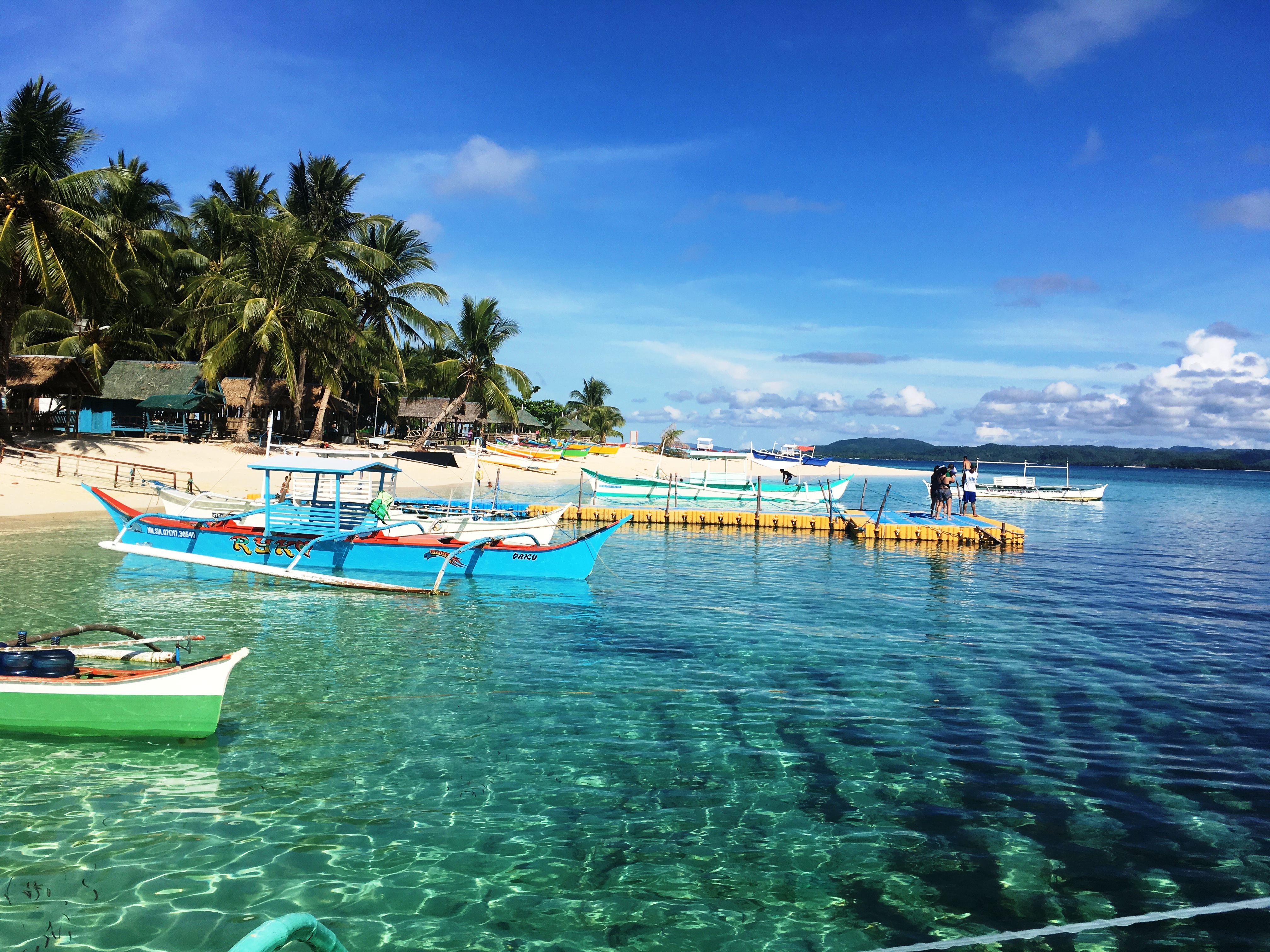
The families who come to us for this journey are usually planning two firsts at once: their children's first long-haul trip, and the family's first time handing the logistics to someone else entirely. The brief sounds like this. Somewhere with warm, calm, swimmable water. Islands with animals and things to spot, not just beaches. Private everywhere, because the idea of shepherding tired kids onto a shared tour boat is its own kind of nightmare. And a pace built around small children, not around a brochure's idea of them. When they name places, the same three come up: Cebu, Bohol, and Siargao.
This itinerary is our answer to that brief. Twelve days, four bases, one loop through the three friendliest islands in the country for families: two quiet jet-lag days on Mactan before anything is asked of anyone, Bohol for tarsiers and turtles and hills that turn copper at sunset, Siargao for a lagoon the colour of bottle glass and rock pools that exist only at low tide. Every day is built around a morning and an evening, with the heat of the afternoon given to shade, pools and naps. Nothing happens before breakfast. Nothing important ever shares a day with a long flight home.
How to Read This Itinerary
The experiences are identical at every tier. What the tiers change is where you sleep, how many unhurried days sit between the outings, and how much of each island is yours alone. Refined stays in family four-star resorts with lagoon pools and connecting rooms. Elevated moves to a five-star suite on Mactan, a two-bedroom suite on Panglao, and an exclusive-use villa on Siargao. Sovereign takes private pool villas, a dedicated host who travels with your family the whole way, and an all-inclusive hideaway on Siargao with its own children's village. A Sovereign day is quieter than a Refined one, not busier.
Mactan, Cebu → Panglao, Bohol → Siargao → Mactan, Cebu. Twelve days, eleven nights, two short flights and two ferry crossings, all private transfers, one direction, no backtrack. The window that makes it work: late March through May, when Bohol and Cebu are at their driest and Siargao's settled season has begun, with the Easter school holidays sitting right inside it.
Days 1 to 2: Mactan, and Letting the Clocks Catch Up
You come off a one-stop flight from Europe, most likely through Hong Kong, Singapore or the Gulf, and find a car waiting with booster seats already fitted. The Philippines runs seven or eight hours ahead of the UK, so these first two days ask nothing of anyone. Breakfast whenever it happens. The pool in the morning before the heat builds, a long lunch in the shade, a nap nobody admits to, then the water again at four, when the light goes soft and gold. Dinner early, and bed. If the kids wake at 3am on the first night, that is normal, and room service knows to expect it.
Mactan's shallows are calm and current-free, and the resorts here are built around them: saltwater lagoons with sandy edges shallow enough for a five-year-old, waterslides, and protected house reefs where the first fish of the trip appear in water barely deeper than the children standing in it.
High-back booster seats fitted in every vehicle, because the taxis most visiting families ride in are exempt from the child-restraint law and most drivers here do not carry them. Children's life jackets sized to each child's weight aboard every boat. Long-sleeve UV swimsuits and reef shoes waiting at the first hotel. Family rooms with the children's beds close to yours and blackout blinds for the jet-lag nights. Children's menus briefed at every property. And a vetted childminder on call at each base, so the two of you can have a dinner alone if you would like one.
Days 3 to 6: Bohol, at Kid Speed
A mid-morning crossing on the fast ferry, in the enclosed air-conditioned cabin, across the sheltered water of the Bohol Strait, and twenty minutes later you are on Panglao island. By mid-afternoon the children are in the water and the unpacking can wait.
The countryside day leaves around ten, in short legs. First the tarsier sanctuary at Corella, run by the Philippine Tarsier Foundation, where the animals live free in the forest and a guide walks you quietly to wherever each one has chosen to sleep that morning: enormous eyes, a body that would fit in a child's palm. We go there and never to the roadside enclosures elsewhere on the island, where tarsiers are caged. The sanctuary asks for silence, which can be hard at five, so we make it a game before you arrive: whoever spots a tarsier first gets to whisper it to everyone else. Then the cool, cathedral dimness of the Bilar mahogany forest, a slow lunch beside the river at Loboc, and the Chocolate Hills last, in the late afternoon when the tour coaches have gone and the low sun turns more than a thousand grassy domes from green to copper.
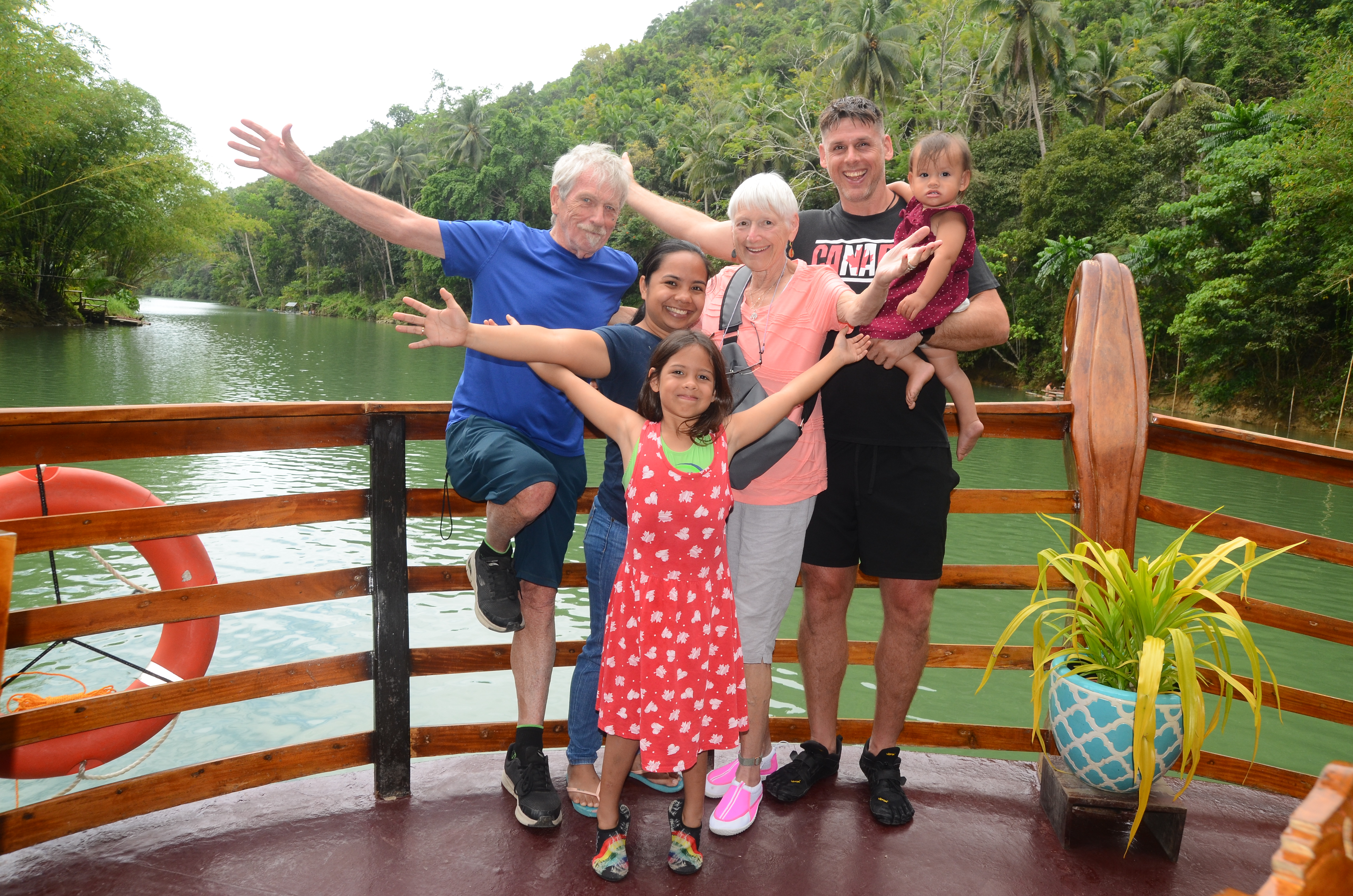
The sea day is your own bangka, the Filipino outrigger with its bamboo arms steadying it on the water. Most boats chase dolphins at dawn; we skip the dawn and reach Balicasag mid-morning, when they have gone and the sun comes straight down through the water over the reef. Green turtles graze on the seagrass two to five metres below, unbothered by a small snorkeller floating above them. Your guide swims beside the children with a float they can hold whenever they like, and everyone stays on the shallow, calm reef flat. If the tide is low on the way home, the crew stops at a vanishing sandbar for fresh mango and a paddle.
Between outings sit the slow days: no schedule at all, the pool, the warm shallows of Panglao, books and naps and whatever the children invent. And on whichever evening feels right, the fireflies. You set off by kayak in the late afternoon through tunnels of mangrove, herons lifting ahead of you, and as the light goes you wait on the dark water while the trees along the bank begin to flicker, then blink, then glow, hundreds of them, pulsing almost in time. The children ride in a tandem kayak with a guide who paddles when arms get tired. Home by eight, dinner in pyjamas.
On the way to Bohol, one extra night turns the country's most famous animal encounter from an ordeal into a highlight. Instead of crossing straight across the strait, you drive south down Cebu's coast to Sumilon island, a small island with a white sandbar and a single resort, where the afternoon belongs to the sandbar. Then the one early start of the whole journey: whale sharks come into the bay at Tan-awan from first light, and by six you are in the water with them, fifteen minutes from your bed, the largest fish in the sea gliding past close enough to see its gills move. The reason we sleep beside the sharks instead of day-tripping them: a day trip means leaving at around 2:30am, or a 5am pickup and four hours on open-water boats in an eleven-hour day. Neither is a fair ask of a six-year-old. Families who would rather see them wild should ask about Donsol instead, where the sharks gather unfed from February to May; it needs its own flights and two nights.
Days 7 to 10: Siargao, Beyond the Surf
There is no direct way from Bohol to Siargao, so this is the one real travel day of the journey and we say so plainly: a late-morning ferry back across the strait, lunch on Mactan, a short afternoon flight over the Mindanao Sea, and a drive across the island. Around seven hours door to door, planned so nobody waits anywhere uncomfortable, with a bag of snacks and games packed for the children. You arrive in time to watch the sun go down over the palms.
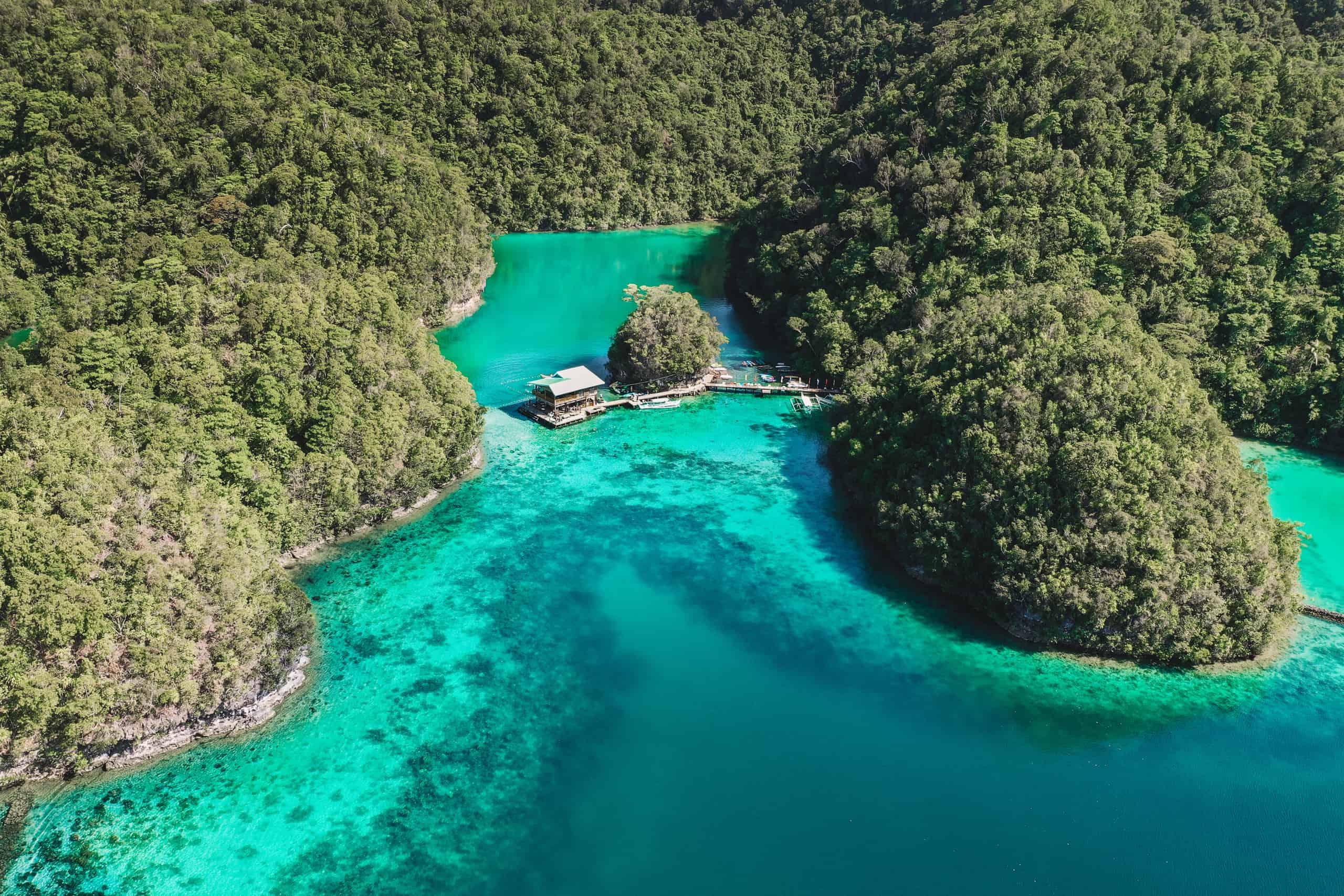
Siargao is famous for its waves, and almost none of what you will do here involves them. On the arrival evening your guide drives inland through a green sea of coconut palms to the Maasin River, where an old palm bends out low over clear, slow water and children queue to jump from it. Another day belongs to Sugba Lagoon: a private boat slips through the largest mangrove forest in the Philippines, twenty minutes of green channels and silent water, then opens without warning into an enclosed, still lagoon walled by limestone and forest. There is a floating platform with a low jumping board, kayaks and paddleboards, and the kind of water that turns a nervous swimmer into a brave one by lunchtime. Visits are limited to about three hours, which is precisely the right length for children. Life jackets stay on the whole time, jumping included: the lagoon is several metres deep right off the platform.
Then the tide days. On one morning, when the tide table says so, your guide takes you up the east coast to Magpupungko, where low water leaves behind a chain of natural rock pools, clear and still and big enough to swim across, with the Pacific breaking white on the rocks beyond them. They exist for only a few hours around low tide, which is exactly what makes them feel like a secret. On another, your bangka takes ten minutes to Guyam, a round islet of palms small enough for the children to walk around while you find some shade, then on to Daku, where the boatmen grill the morning's fish for lunch. We leave the bare sandbar islands out on purpose: no shade at all is no place for a small child at midday. And if the eldest wants to stand on a surfboard, a one-to-one lesson on a soft board at a gentle break inside the reef, with an instructor who teaches children every week. Optional, and quite likely to become the story she tells at school.
Sohoton Cove and its lagoon of stingless jellyfish appear on every Siargao list. From General Luna it is around two hours each way by open-water boat, with a start time set by the tide and some scrambling through caves once you are there. For an older child it is an adventure; for a six-year-old it is mostly a very long boat ride. If your children are older when you travel, we will build it in.
Days 11 to 12: Back to Mactan, and the Buffer Night
A late-morning flight back to Cebu and the same resort you started in, which the children will greet like an old friend. A last afternoon in the water, an early dinner, suitcases packed while two tired parents sleep. The next morning, a car timed to your flight home.
This last night exists for one reason. Small aircraft in and out of Siargao are occasionally delayed by weather, and no family should find that out on the morning of a long-haul departure. No sea crossing and no island flight on this route ever shares a day with the flight home.
Why This Loop Works
Anyone can list three islands. The craft is in the shape: two days down before anything is asked of anyone, one move per morning and never more, the heat of every afternoon given to pools and shade, an unscheduled day on each island, and a buffer night standing between the small airplanes and the big one. Filipinos adore children, and the country is kinder to travelling families than almost anywhere in Asia. Built this way, it is the trip children remember, tarsiers and fireflies and the first turtle, long after the beaches blur together.
Frequently Asked Questions
Tell us when you'd like to go.
Every Arkipelago journey begins with a conversation. We'll respond within 24 hours.
Begin Your JourneyRelated reading: A 14-Day Philippines Itinerary for Two: Boracay, Palawan and Coron · Private Tours in the Philippines: What They Actually Look Like · A Philippines Honeymoon Over the Holidays