We have been to both. As a couple early on, when El Nido still had long stretches of quiet. As a family with our children. With my in-laws visiting from Canada — seniors making their first trip to the Philippines — watching them fall completely in love with a place they'd never expected to. In El Nido, we brought our dog kayaking to a secret cove, and she spent the session hopping from one kayak to another while strangers stopped to photograph her. Both destinations have given us memories we still talk about. Neither is simply better. They are genuinely different — and which one belongs in your itinerary depends entirely on what kind of trip you're actually planning.
This is the honest version of that answer.
El Nido: What It Is Now, and Who It's Right For
El Nido has been comprehensively discovered. That is the starting point for any honest conversation about it. The lagoons are queued. The main tour routes run on a schedule shared by dozens of boats. The town now runs at the full speed of high-season international tourism.
And yet. El Nido earns its reputation. The Bacuit Archipelago is genuinely extraordinary — the limestone karsts, the hidden coves, the quality of the light in the late afternoon over the South China Sea. None of that is manufactured.
Las Cabanas is worth knowing about specifically. A short tricycle ride from El Nido town — a beach with enough space to find your own patch of sand, calm enough water for swimming, the kind of unhurried afternoon that reminds you what beach days are supposed to feel like. We have spent hours there doing nothing in particular, which is precisely the point.

El Nido, Bacuit Archipelago — kayaking the lagoons with Holly. She was unbothered. The karsts were not.
El Nido also welcomes the kind of day that doesn't fit neatly into an itinerary. On one of our own trips, we brought our dog kayaking to a secret cove off the main tour route — she spent the entire session hopping from one kayak to another, completely unbothered, while the other paddlers stopped to watch. That kind of unscripted afternoon is something El Nido, at its best, still delivers.

The view from behind: our dog claimed the bow of every kayak we put her on. She was not wrong about the vantage point.
El Nido town also has real evening options — restaurants, bars, a genuine street life — in a way that Coron town, which is quieter and less developed, does not. For travellers who want activity and variety on the ground as much as on the water, El Nido has the infrastructure to support it.
The honest summary: El Nido suits independent travellers and active couples who want a balance of water activities and a town with options. It suits families with older children who want variety and easy logistics. It suits travellers who don't need solitude to feel like they've had an experience. If that's your trip — El Nido will not disappoint.
"We brought my in-laws from Canada — seniors, first trip to the Philippines. They fell completely in love with it. El Nido has a way of doing that to people."
Coron: More Rugged, More Remote, More Rewards
Coron is less developed than El Nido. That is not a complaint — it is the point. The town is smaller, the infrastructure is more basic, the evenings are quieter. What Coron offers in exchange is access to experiences that El Nido simply cannot match, and a pace that makes the places feel like yours rather than shared.
There is a moment, about seven minutes into the hike over the karst ridge above Coron Bay, when the path crests and Kayangan Lake appears below you without warning. Not gradually — suddenly. A lake enclosed entirely by limestone, so still and clear in the early morning that the reflection of the cliffs above it looks more real than the cliffs themselves. The water is the colour of things you'll spend the rest of your life trying to describe. There are, at this hour, no other people.
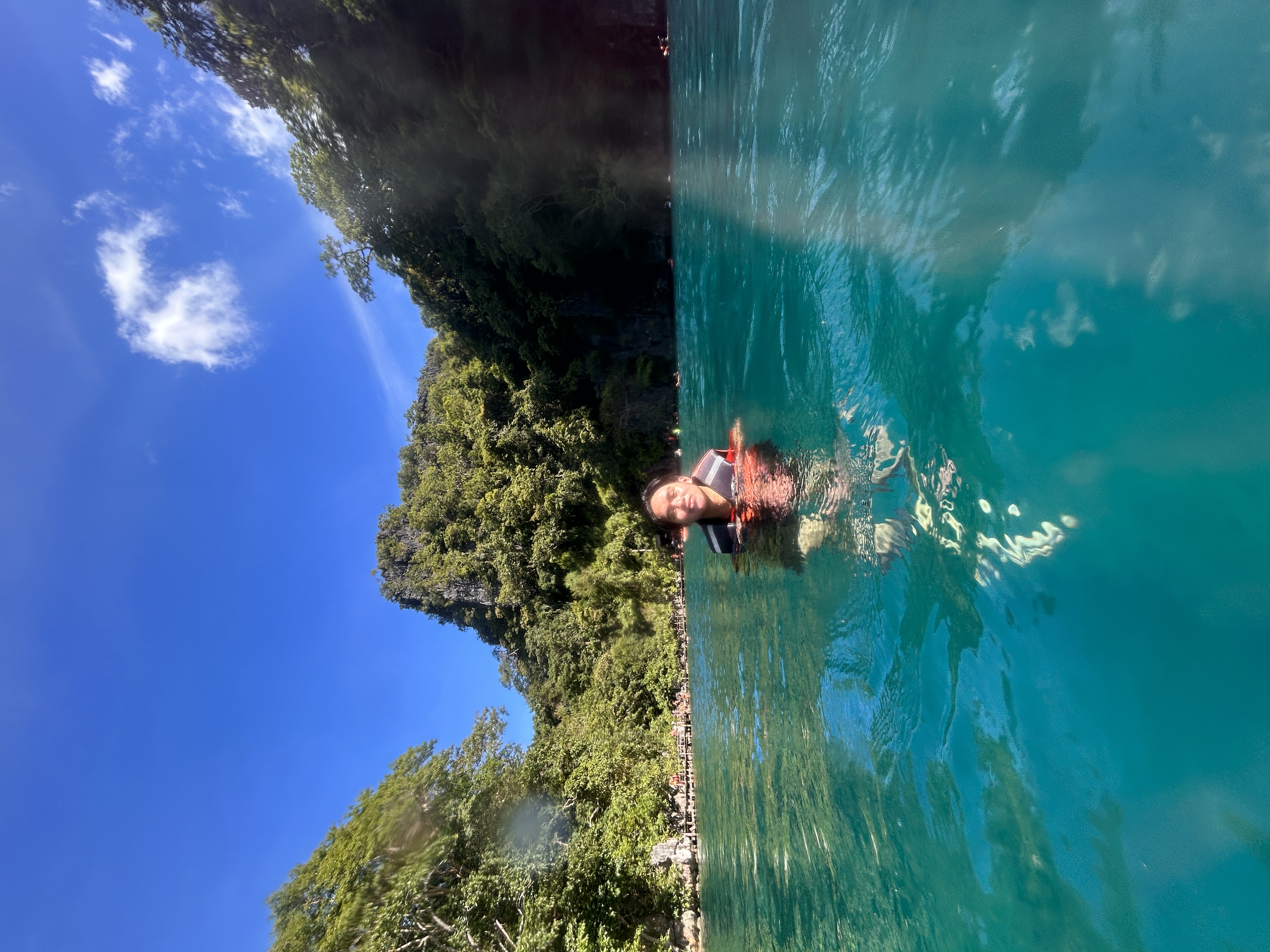
Inside Kayangan Lake, Coron Island. The water stays this colour all day. The crowd arrives after 9am — arrive before it.
The Shipwrecks: A Palawan Experience El Nido Simply Cannot Offer
In September 1944, American aircraft sank a fleet of Japanese supply ships in Coron Bay. They are still there. Twelve major wrecks in water shallow enough for recreational divers, deep enough to have become extraordinary artificial reefs — coral-encrusted, fish-dense, eerie in the particular way that only things built for one purpose and converted by time to another can be.
The Okikawa Maru sits at 10 to 47 metres. The Irako — a refrigeration ship — at 36 metres. The Kogyo Maru, its cargo holds still recognisable after eighty years. These are among the finest wreck dives in the world, and they are accessible from Coron town in under an hour by private pump boat.
For couples where one or both partners dive, or where a dive certification is on the list, this alone justifies the choice of Coron over El Nido. El Nido has beautiful reef diving. It has nothing that compares to this.
For non-divers: the wrecks are visible from the surface in shallower sites, and snorkelling over them gives enough of the scale and atmosphere to understand why divers return to Coron specifically for this. We have planned itineraries where one partner dives and the other snorkels above, meeting afterwards on the boat with genuinely different but equally valid accounts of the same site.
One more thing El Nido doesn't have: Calauit Safari Park on Busuanga Island, where a herd of African wildlife — giraffes, zebras, impalas — roam a protected reserve introduced in the 1970s. It is completely surreal and completely real, and children reliably lose their minds at it. We have been, multiple times. The giraffes are not shy.

Calauit Safari Park, Busuanga Island. The giraffes were introduced in 1977. They have made themselves entirely at home.
Twin Lagoon: The One That Doesn't Need an Early Start
Twin Lagoon is two connected tidal lagoons on Coron Island — accessible by kayak through a low limestone arch, or by swimming through a gap in the rock depending on the tide. No motorised boats are permitted inside. The water shifts between temperatures as you move deeper — freshwater springs meeting saltwater at different layers.
What makes Twin Lagoon worth knowing about for couples is what isn't there. No tour boat engines. No commentary over a loudspeaker. The only sounds are water, birds, and whatever conversation you bring with you.
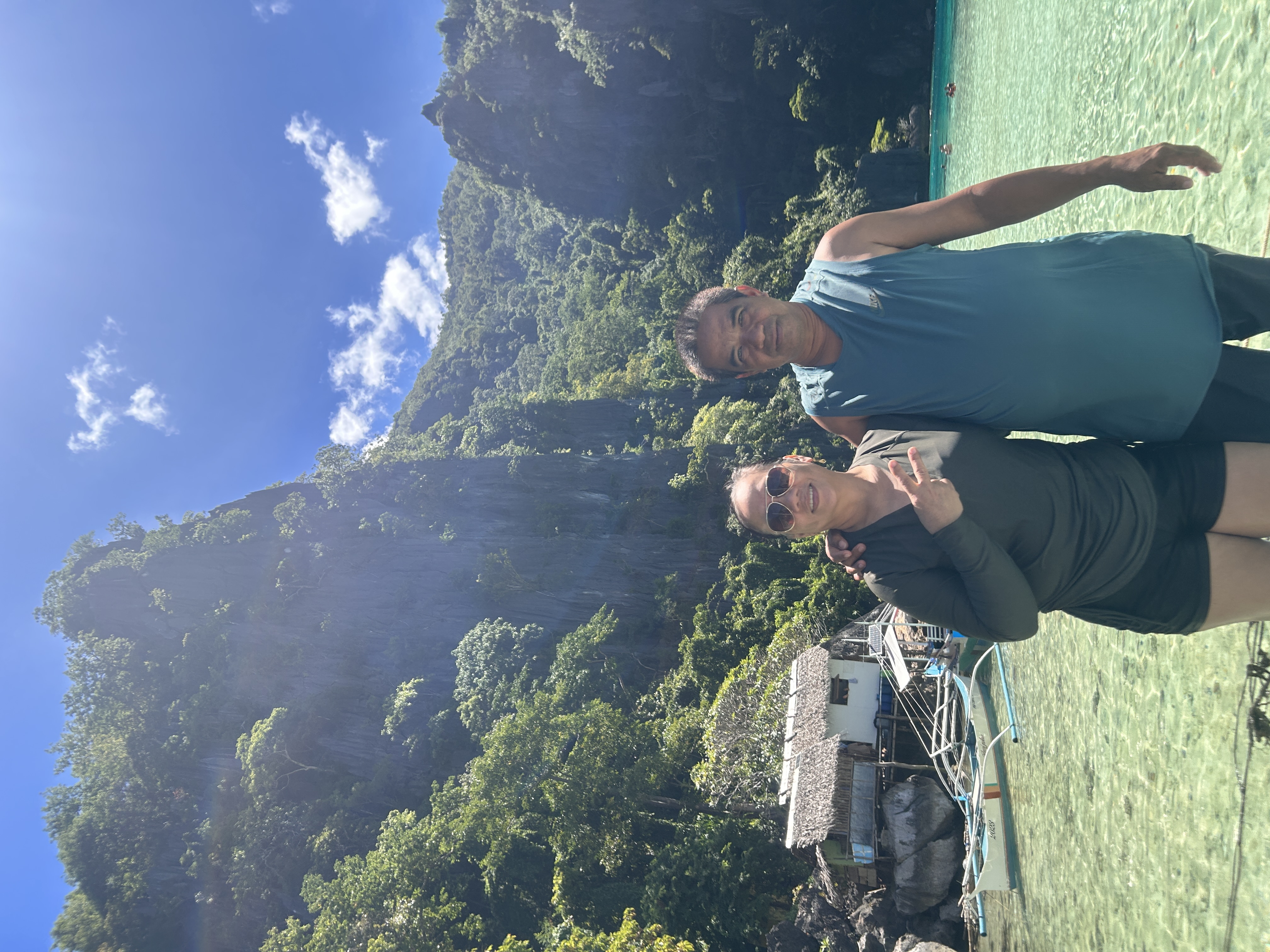
Twin Lagoon shore — the bangka, the karsts, and nowhere to be.

The same spot, different trip — Coron works at every stage of life.
Coron has several private island resorts in the Calamian Group where buyouts and exclusive beach access are possible in a way El Nido's busier waters make difficult. If a proposal is part of the trip, Coron's private island options give us the kind of control over the moment that a shared tour route simply cannot. We have used these settings for proposals and they work — because there is no one else there.
Planning a journey to Coron or El Nido?
Tell us what you're imagining — we'll come back within 24 hours with initial thoughts on your itinerary.
Begin Your JourneyCoron Town vs El Nido Town
This is where the trade-off becomes most visible. El Nido town has options — restaurants across every price range, bars with a genuine evening atmosphere, a street life that makes the nights feel like part of the trip rather than time to fill before the next morning. If town energy matters to you, El Nido has it and Coron does not.
Coron town is a working fishing community that hasn't yet been fully converted. The restaurants are smaller, the options fewer. But what you find in the kitchens that have been here for decades — tamilok (a Palawan woodworm delicacy, genuinely worth trying), freshly caught fish prepared simply, the kind of rice and soup that makes you understand why Filipino food is so underrated internationally — is something El Nido's tourist-facing strip has largely lost.
The Honest Comparison
| Coron | El Nido | |
|---|---|---|
| Best for | Divers, adventurous couples, proposal trips, private island stays | Independent travellers, active couples, families with older children |
| Development level | Less developed — quieter, more rugged | More developed — more options, busier pace |
| Signature experience | Kayangan Lake, WWII shipwrecks — genuinely unique | Bacuit Archipelago lagoons, Las Cabanas beach |
| Town evening options | Limited — quiet, local, slower pace | Strong — restaurants, bars, street life |
| Privacy available | Yes — private islands, private boats, early starts | Possible but requires more planning |
| Proposal / romantic trip | ✓ Strongly suited — private island options available | Possible with Amanpulo or outer island access |
So Which One?
The question we get most often is: can we do both? The answer is yes — and for clients with ten days or more, the Classic Palawan journey combines Port Barton or El Nido with Coron into a single itinerary that gives you the best of both. You get the activity and variety of the south, and the dramatic ruggedness of the north. The contrast between them is part of what makes the journey work.
For shorter trips where a choice is required: if you dive, or if you want a private island proposal setup, or if solitude is more important than evening options — Coron. If you want variety on the water and in the town, beach days with room to breathe, or you're travelling with family members who want activity options — El Nido. Both are worth it. Neither is the wrong answer. The right one is the one that matches how you actually want to spend your days.
Frequently Asked Questions
Begin Your Palawan Journey
No fixed packages. No price lists. Just a conversation with people who know these islands.
Request a Journey Consultation